
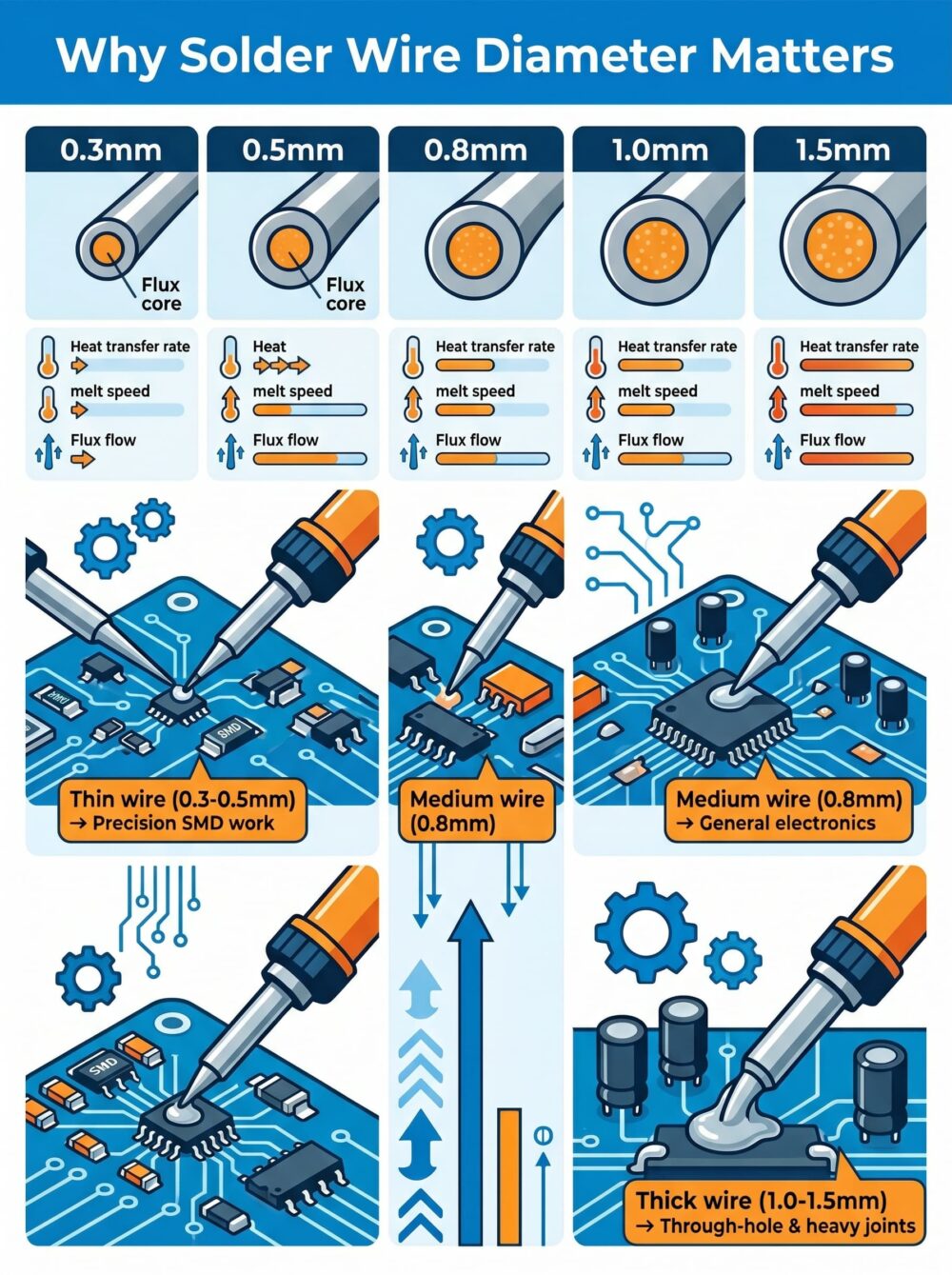
The right solder wire diameter depends on the size of the joint. Use 0.5mm for fine SMD work, 0.8mm for general electronics, and 1.0mm for heavy joints like power leads and ground planes. A wire that is too thick floods small pads. A wire that is too thin wastes time on big joints and can cause cold connections.
This guide explains how diameter affects heat transfer, joint quality, and tip life on your Xytronic station. It also shows which size to keep on your bench for each task type.
Why Solder Wire Diameter Matters
Solder wire diameter controls how much metal you add per second. A thicker wire delivers more solder and more flux in one touch. A thinner wire gives you finer control but melts faster.
The diameter also changes how heat moves into the joint. Thick wire pulls heat from the tip and the pad at the same time. If your tip is too small or your temperature is too low, the joint may not reach the melting point. This is one common cause of cold joints, which we cover in our troubleshooting tree.
Matching wire diameter to the job protects your work in three ways:
Better heat balance — the tip, pad, and solder all reach melting temperature together.
Cleaner joints — the right amount of solder flows into the pad without bridging.
Longer tip life — you spend less time on each joint, so the tip stays tinned and oxidises slower.
0.5mm Solder Wire: For Fine SMD and Precision Work
0.5mm wire is the smallest size most people use. It suits surface-mount components such as 0805, 0603, and 0402 resistors, small QFP chips, and fine-pitch connectors.
This diameter melts almost instantly on contact with a hot tip. That speed is useful for tiny pads, where too much solder causes bridges between pins. It also pairs well with conical and bevel tips, which need a steady, slow feed of solder.
Best uses for 0.5mm wire:
SMD resistors and capacitors down to 0402 size.
Fine-pitch IC pins on phones, consoles, and small boards.
Drag soldering across rows of close-set leads.
Touch-up work where a single pin needs reflow.
One trade-off is cost. 0.5mm wire has less metal per metre, so a 100g spool runs out faster than a thicker spool of the same weight. Keep this size for detail work only.
0.8mm Solder Wire: The General-Purpose Choice
0.8mm wire is the most common size on a hobby or repair bench. It works for through-hole boards, headers, switches, JST connectors, and most repair tasks.
The diameter gives you enough solder to fill a standard pad in one or two touches. It also melts fast enough to avoid lifting the pad. Many users keep one spool of leaded 0.8mm and one spool of lead-free 0.8mm, which matches our lead-free vs leaded preset guide.
Best uses for 0.8mm wire:
Through-hole resistors, diodes, and capacitors on standard PCBs.
Pin headers and IC sockets with 2.54mm spacing.
JST, Dupont, and other small connectors.
General repair where joint size varies from pin to pin.
If you can only buy one spool, choose 0.8mm. It handles around 80 percent of jobs without changing wire.
1.0mm and Thicker Wire: For Heavy Joints and Ground Planes
1.0mm wire and thicker sizes are made for high-mass joints. These include power leads, audio jacks, ground planes, copper braids, and battery tabs.
Heavy joints sink heat fast. A thin wire melts before the pad is hot enough, which leads to a grainy, weak joint. A thicker wire carries more flux and more metal, so the joint reaches the melting point cleanly. Pair this size with a chisel or hoof tip that has enough mass to deliver heat quickly.
Best uses for 1.0mm wire:
Power and battery wiring on RC vehicles, drones, and tools.
Audio jacks and large connectors with thick metal contacts.
Ground planes and shield cans on RF boards.
Wire splicing for speaker leads and motor leads.
For very heavy work, some users move to 1.2mm or 1.5mm wire. These sizes need higher tip temperatures and short dwell times, which we explain in our small pads to heavy grounds tuning guide.
How Diameter Interacts With Temperature and Tip Choice
Wire diameter, tip shape, and temperature work as a system. A thick wire with a small tip will not transfer enough heat. A thin wire with a high temperature will burn the flux before it can clean the joint.
Use these pairings as a starting point on your Xytronic station:
0.5mm wire + conical or fine bevel tip + 320–340°C (leaded) for SMD work.
0.8mm wire + 1.6mm chisel tip + 340–360°C (leaded) for general boards.
1.0mm wire + 3mm chisel or hoof tip + 360–380°C (leaded) for heavy joints.
Add 20–30°C for lead-free solder, which has a higher melting point. Our temperature control article covers the science behind these settings, and the three go-to presets guide shows how to save them on your station.
Flux Core Type and Diameter
Solder wire holds flux inside the metal core. Thicker wire carries more flux per millimetre, which helps clean oxidised pads and large surfaces. Thin wire carries less flux, so you may need extra liquid or gel flux for harder joints.
Three common flux types appear in modern wire:
Rosin (RA / RMA) — strong cleaning, leaves visible residue, common in classic electronics.
No-clean — leaves a small clear residue that does not need washing, common for repair work.
Water-soluble — strong cleaning, but the residue must be washed off with water.
For most users, no-clean flux core in 0.5mm and 0.8mm covers daily work. Keep a small bottle of liquid flux nearby for ground planes and oxidised boards.
How Much Solder Wire to Buy
A 100g spool of 0.8mm wire lasts most hobbyists six to twelve months. SMD users go through 0.5mm wire faster because each joint uses less metal but more touches.
A simple bench setup looks like this:
One 100g spool of 0.5mm for SMD and fine-pitch work.
One 250g or 500g spool of 0.8mm as the daily driver.
One 100g spool of 1.0mm for heavy joints and wire splicing.
Store all spools in a dry box or sealed bag. Flux absorbs moisture from the air, which weakens the joint over time. This matters more in classroom or lab settings, which we cover in our classroom setup guide.
Common Mistakes With Solder Wire Diameter
Most diameter problems come from using one size for every job. Watch for these signs:
Bridges between SMD pins — your wire is too thick. Switch to 0.5mm and lower your feed speed.
Cold or grainy joints on power leads — your wire is too thin. Switch to 1.0mm and raise the temperature 10–20°C.
Burnt flux smell and dark residue — your tip is too hot for the wire size. Drop the temperature or use thicker wire.
Tip oxidising fast — long dwell times are eating the tip plating. Use thicker wire on big joints to finish faster, and follow our care and maintenance routine.
Quick Reference: Wire Size by Job Type
Use this short list as a bench reminder:
SMD 0402 to 0805, fine-pitch ICs: 0.5mm
Through-hole boards, headers, JST connectors: 0.8mm
Power leads, audio jacks, ground planes: 1.0mm
Battery tabs, speaker wires, shield cans: 1.0mm or 1.2mm
Pick the wire that matches the largest joint in your session. You can always feed it slower for smaller joints, but you cannot add metal a thin wire does not carry.
Final Thoughts
Solder wire diameter is a small choice that changes the quality of every joint you make. Keep three sizes on your bench, match each one to the job, and pair it with the right tip and temperature on your Xytronic station. This single habit reduces cold joints, bridges, and wasted time more than any other change you can make to your workflow.
For a deeper look at how heat moves from the tip into the joint, read our guide on wattage range and heat delivery. To set up your bench for safe, repeatable results, see the ESD work area setup guide.