
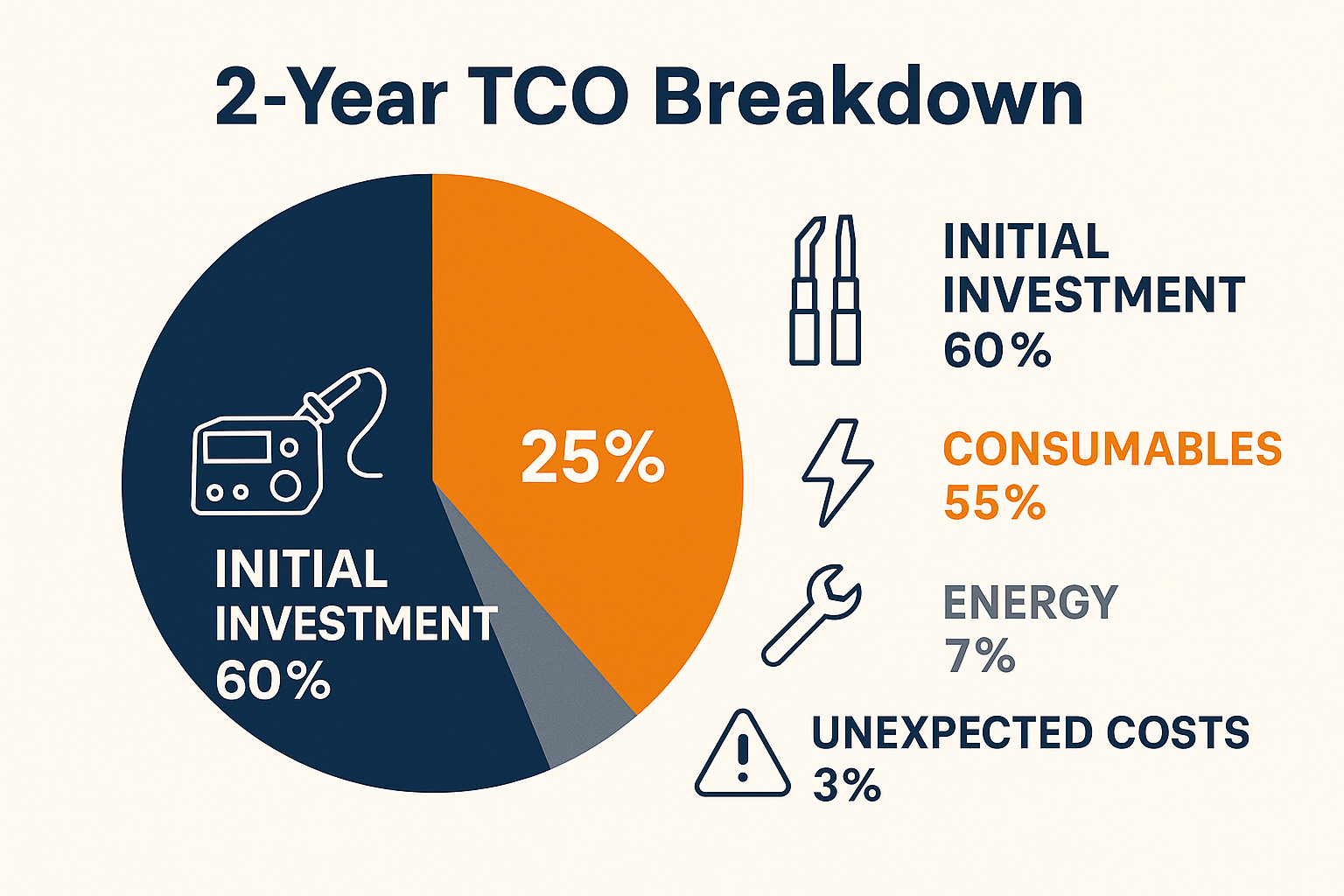
When I first started calculating the total cost of ownership (TCO) for my soldering station, I was shocked to discover that the initial purchase price represented only 60% of my actual expenses over two years. The hidden costs of tips, consumables, and maintenance quickly added up, turning what seemed like a budget-friendly investment into a much larger financial commitment.
Understanding the true cost of owning a soldering station is crucial for both electronics engineers managing department budgets and hobbyists planning their workshop investments. Whether you’re considering your first station or upgrading your current setup, knowing what to expect beyond the sticker price will help you make informed decisions and budget appropriately.
Key Takeaways
• Initial cost represents only 50-70% of total ownership expenses over two years
• Soldering tips account for 15-25% of ongoing costs, with replacement frequency varying by usage intensity
• Consumables like solder, flux, and cleaning supplies add $50-200 annually depending on project volume
• Energy consumption and maintenance contribute an additional 5-10% to total costs
• Strategic purchasing and proper maintenance can reduce TCO by up to 30%
Understanding Total Cost of Ownership (TCO) for Soldering Stations
Total Cost of Ownership extends far beyond the initial purchase price of your soldering station. It encompasses every expense associated with operating, maintaining, and using your equipment over its entire lifespan. For soldering stations, this includes consumables, replacement parts, energy costs, and even the hidden costs of downtime.
The concept becomes particularly important when comparing different soldering station models. A cheaper station might seem attractive initially, but poor temperature control can lead to increased tip consumption and wasted solder, ultimately making it more expensive than a premium model with better efficiency features.
Why TCO Matters for Electronics Work
Unlike many tools that require minimal ongoing investment, soldering stations demand regular consumable replacements. The precision nature of electronics work means that worn tips, contaminated flux, or low-quality solder can compromise project quality and waste valuable time. Understanding these costs upfront helps you:
- Budget accurately for your electronics projects
- Choose the right station based on true long-term value
- Plan maintenance schedules to minimize unexpected expenses
- Optimize consumable usage to reduce waste
Breaking Down the Initial Investment
The foundation of your TCO calculation starts with the initial purchase, which typically includes several components beyond just the base station.
Base Station Costs
Entry-level soldering stations suitable for hobbyist work range from $50-150, while professional-grade units can cost $200-800 or more. Mid-range stations offering good temperature control and safety features typically fall in the $100-300 range.
Essential Accessories and Setup
Your initial investment should include:
- Soldering iron holder/stand: $15-50
- Cleaning sponge or brass wool: $5-15
- Initial tip set: $20-60
- Basic flux and solder: $15-30
- ESD protection accessories: $25-75
This brings your true starting investment to roughly 125-150% of the base station price.
Optional but Recommended Additions
- Fume extraction system: $50-200
- Additional tip shapes for versatility: $30-80
- Temperature calibration tools: $40-150
- Ergonomic accessories: $20-60
Consumables: The Ongoing Expense Categories
The consumables category represents the largest portion of your ongoing costs and varies significantly based on your usage patterns and project types.
Soldering Tips: Your Most Critical Consumable
Soldering tips are simultaneously your most important and most expensive ongoing cost. Tip compatibility and selection directly impacts both performance and replacement frequency.
Tip Replacement Frequency by Usage Level:
| Usage Level | Hours/Month | Tip Lifespan | Annual Tip Cost |
|————-|————-|————–|—————–|
| Light Hobbyist | 5-10 | 8-12 months | $15-30 |
| Regular User | 20-40 | 4-6 months | $40-80 |
| Professional | 80-160 | 2-3 months | $120-240 |
| Production | 160+ | 1-2 months | $300-600 |
Factors Affecting Tip Longevity:
- Temperature settings: Higher temperatures accelerate tip degradation
- Cleaning frequency: Regular cleaning extends tip life significantly
- Solder type: Lead-free solders require higher temperatures, reducing tip lifespan
- Storage conditions: Proper storage prevents oxidation
- Flux quality: Corrosive flux can damage tips
Solder: Quality vs. Quantity Considerations
Solder consumption varies dramatically based on project types, but most users can estimate their needs based on joint count and wire gauge.
Annual Solder Consumption Estimates:
- Light hobbyist: 0.5-1 pound ($20-40)
- Regular user: 1-3 pounds ($40-120)
- Professional: 3-10 pounds ($120-400)
Solder Quality Impact on TCO:
Higher-quality solder with good flux cores can reduce:
- Rework time by 20-30%
- Flux consumption by 40-50%
- Joint failures by 60-80%
Flux: The Unsung Hero of Consistent Results
Flux consumption often gets overlooked in TCO calculations, but it’s essential for professional-quality work.
Types and Consumption Rates:
- Rosin flux paste: $8-15 per 30g tube, lasting 3-6 months for regular users
- No-clean liquid flux: $12-25 per bottle, lasting 4-8 months
- Water-soluble flux: $10-20 per container, lasting 2-4 months
Cleaning and Maintenance Supplies
Regular cleaning is crucial for maintaining performance and extending component life.
Essential Cleaning Supplies (Annual Costs):
- Cleaning sponges: $10-20
- Brass wool: $15-25
- Tip tinner/cleaner: $8-15
- Isopropyl alcohol: $10-20
- Cotton swabs and wipes: $15-30
Energy Consumption and Operating Costs
Modern soldering stations are relatively energy-efficient, but understanding their consumption helps complete your TCO picture.
Power Consumption Analysis
Most soldering stations consume 40-80 watts during active use, with standby consumption of 5-15 watts. Auto-sleep and auto-shutoff features can significantly reduce energy costs.
Annual Energy Cost Calculations (at $0.12/kWh):
- Light use (50 hours/year): $2-4
- Regular use (200 hours/year): $8-15
- Professional use (800 hours/year): $30-60
- Production use (2000+ hours/year): $75-150
Efficiency Features That Reduce Costs
- Rapid heat-up: Reduces warm-up energy waste
- Precise temperature control: Minimizes overshooting and energy waste
- Sleep modes: Cut standby consumption by 70-90%
- Auto-shutoff: Prevents accidental overnight operation
Maintenance and Replacement Costs
Proper maintenance extends equipment life and prevents costly failures, but it does require ongoing investment.
Scheduled Maintenance Requirements
Monthly Tasks:
- Deep cleaning of station and iron ($2-5 in supplies)
- Tip inspection and conditioning ($1-3)
- Cable and connection checks (time investment)
Quarterly Tasks:
- Calibration verification ($5-10 if professional service needed)
- Internal cleaning and inspection
- Replacement of worn accessories
Annual Tasks:
- Professional calibration service: $50-100
- Deep maintenance and part replacement: $20-50
Component Replacement Schedule
Beyond tips, other components have predictable replacement cycles:
- Heating elements: 2-5 years ($30-80)
- Temperature sensors: 3-7 years ($20-50)
- Power cords: 5-10 years ($15-30)
- Stands and holders: 3-8 years ($20-60)
Hidden Costs and Unexpected Expenses
Several costs aren’t immediately obvious but can significantly impact your TCO.
Productivity Losses
- Warm-up time: Stations without rapid heat-up waste 2-5 minutes per session
- Temperature instability: Poor control leads to rework and material waste
- Ergonomic issues: Poor ergonomics cause fatigue and reduced efficiency
- Equipment failures: Unexpected downtime can cost far more than preventive maintenance
Quality-Related Costs
- Rework expenses: Poor joints require additional time and materials
- Component damage: Overheating can destroy expensive components
- Project delays: Equipment issues can delay deliveries and affect reputation
Safety and Compliance Costs
- ESD protection: Proper ESD safety may require additional equipment
- Ventilation requirements: Fume extraction adds initial and ongoing costs
- Insurance considerations: Professional work may require equipment coverage
Usage Patterns and Their Impact on TCO
Your specific usage pattern dramatically affects your total cost of ownership. Understanding these patterns helps optimize your investment.
Hobbyist Usage (5-20 hours/month)
Typical TCO Breakdown:
- Initial investment: $150-300
- Annual consumables: $50-100
- Energy costs: $5-10
- 2-year total: $260-520
Optimization strategies:
- Choose stations with excellent auto-sleep features
- Buy consumables in smaller quantities to prevent aging
- Focus on tip care to extend replacement intervals
Professional Usage (40-80 hours/month)
Typical TCO Breakdown:
- Initial investment: $300-600
- Annual consumables: $150-300
- Energy costs: $20-40
- Maintenance: $50-100
- 2-year total: $720-1,440
Optimization strategies:
- Invest in higher-quality stations with better temperature control
- Buy consumables in bulk for cost savings
- Implement preventive maintenance schedules
Production Usage (100+ hours/month)
Typical TCO Breakdown:
- Initial investment: $500-1,200
- Annual consumables: $400-800
- Energy costs: $50-100
- Maintenance: $100-200
- 2-year total: $1,550-3,100
Optimization strategies:
- Consider multiple stations to reduce individual wear
- Negotiate bulk pricing for consumables
- Implement formal maintenance and calibration programs
Cost Optimization Strategies
Reducing your TCO doesn’t mean compromising quality – it means working smarter with your resources.
Smart Purchasing Decisions
Station Selection Criteria:
- Choose models with proven temperature control accuracy
- Prioritize energy-efficient designs
- Consider tip compatibility and availability
- Evaluate warranty and service support
Consumable Procurement:
- Buy solder in appropriate quantities to prevent oxidation
- Purchase tips in sets for volume discounts
- Source cleaning supplies in bulk
- Consider generic alternatives for non-critical supplies
Maintenance Best Practices
Daily Habits:
- Clean tips before and after each session
- Use appropriate temperatures for each task
- Store equipment properly when not in use
- Monitor performance indicators
Weekly Routines:
- Deep clean all equipment
- Inspect cables and connections
- Check calibration accuracy
- Rotate tip usage to ensure even wear
Workflow Optimization
Efficiency Improvements:
- Batch similar tasks to minimize temperature changes
- Pre-plan projects to reduce setup time
- Use appropriate settings for different personas
- Implement quality control to prevent rework
Comparing Different Station Types and Their TCO
Different soldering station categories have distinct TCO profiles that affect long-term value.
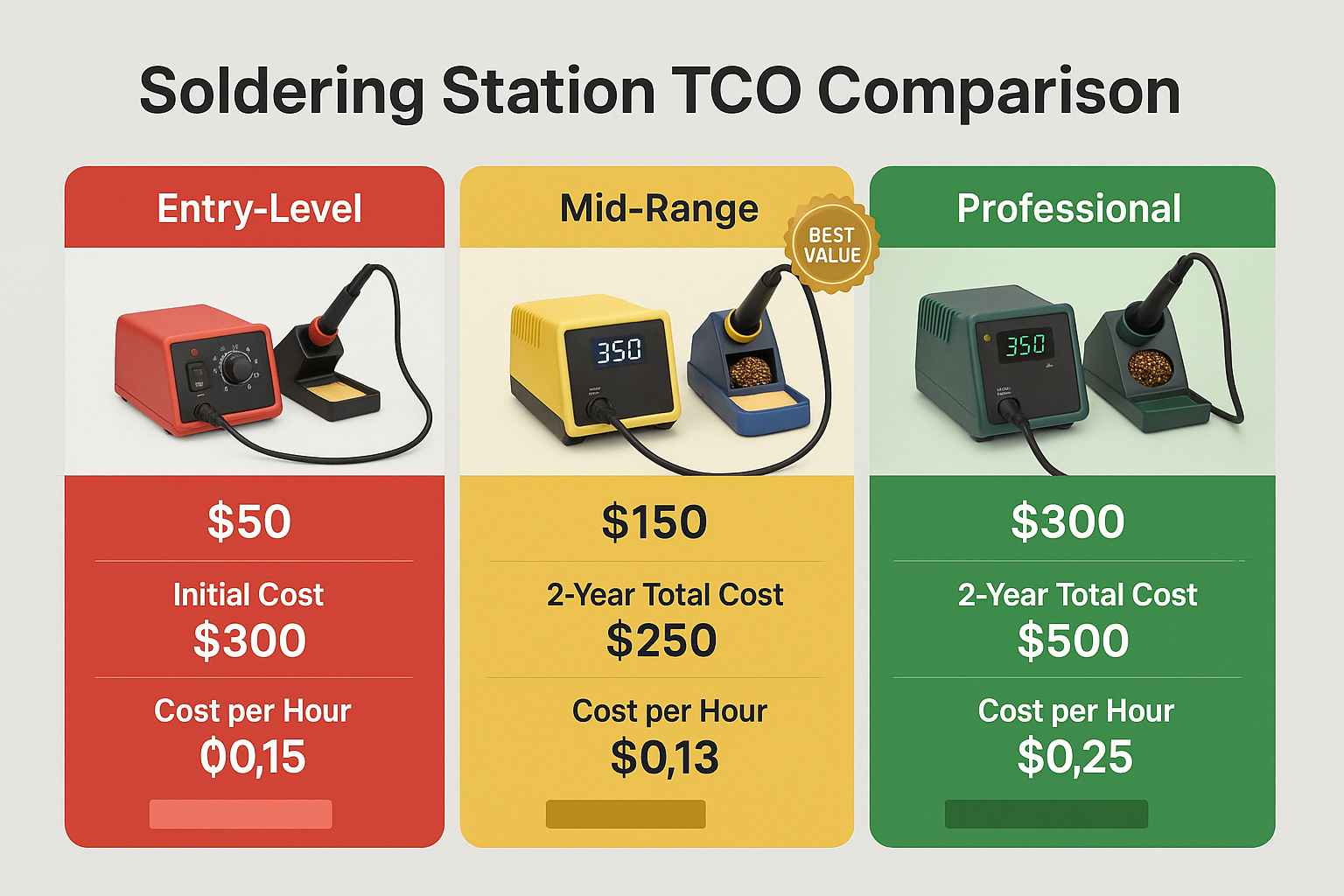
Entry-Level Stations ($50-150)
Pros:
- Low initial investment
- Adequate for basic tasks
- Simple operation and maintenance
Cons:
- Higher consumable costs due to poor temperature control
- Limited tip options increase replacement frequency
- Higher energy consumption
- Shorter overall lifespan
2-Year TCO Range: $200-400
Mid-Range Stations ($150-400)
Pros:
- Good temperature control reduces tip wear
- Energy-efficient operation
- Wide tip compatibility
- Reliable performance
Cons:
- Higher initial investment
- May lack advanced features
- Limited upgrade options
2-Year TCO Range: $350-700
Professional Stations ($400-800+)
Pros:
- Excellent temperature control minimizes consumable waste
- Advanced features reduce operating costs
- Superior build quality extends lifespan
- Comprehensive tip selection
Cons:
- High initial investment
- May be overkill for light users
- Higher maintenance costs
2-Year TCO Range: $600-1,200
💡 Pro Tip: When comparing stations, calculate the cost per hour of use over two years. This metric often reveals that mid-range stations offer the best value for most users.
Real-World TCO Examples and Case Studies
Let me share some real-world examples that illustrate how different usage patterns affect actual costs.
Case Study 1: Weekend Hobbyist
Profile: Arduino projects, occasional repairs, 8 hours/month usage
Equipment: Mid-range station ($200), basic accessories ($75)
Year 1 Costs:
- Tips: $25
- Solder and flux: $35
- Cleaning supplies: $20
- Energy: $8
Year 2 Costs:
- Tips: $30
- Consumables: $40
- Maintenance: $25
- Energy: $8
Total 2-Year TCO: $466 ($2.43 per hour)
Case Study 2: Electronics Repair Technician
Profile: Daily repairs, SMD work, 120 hours/month usage
Equipment: Professional station ($450), comprehensive setup ($200)
Year 1 Costs:
- Tips: $180
- Solder and flux: $120
- Cleaning supplies: $60
- Energy: $45
Year 2 Costs:
- Tips: $200
- Consumables: $140
- Maintenance: $80
- Energy: $50
Total 2-Year TCO: $1,525 ($0.53 per hour)
Case Study 3: Engineering Student
Profile: Course projects, learning experiments, 25 hours/month usage
Equipment: Entry-level station ($120), basic setup ($50)
Year 1 Costs:
- Tips: $45
- Solder and flux: $50
- Cleaning supplies: $25
- Energy: $12
Year 2 Costs:
- Tips: $60
- Consumables: $55
- Replacement iron: $80
- Energy: $15
Total 2-Year TCO: $512 ($0.85 per hour)
Looking for a reliable soldering station that offers excellent value? Shop XYTRONIC soldering stations for professional-grade equipment designed to minimize your total cost of ownership while delivering consistent, high-quality results.
Planning Your Budget: A Practical Framework
Creating an accurate budget requires understanding your specific needs and usage patterns.
Assessment Questions
Before calculating your TCO, answer these key questions:
- How many hours per month will you use the station?
- What types of projects will you tackle most often?
- Do you prioritize initial cost savings or long-term value?
- What’s your tolerance for maintenance and upkeep?
- Are there any specific safety or compliance requirements?
Budget Allocation Framework
Initial Investment (50-70% of 2-year TCO):
- Station: 60-80% of initial budget
- Accessories: 15-25% of initial budget
- Setup costs: 5-15% of initial budget
Annual Operating Costs (15-25% of 2-year TCO):
- Consumables: 70-80% of annual costs
- Energy: 5-10% of annual costs
- Maintenance: 10-20% of annual costs
Contingency Fund (5-10% of 2-year TCO):
- Unexpected repairs
- Additional accessories
- Upgrade opportunities
Tracking and Optimization
Monthly Reviews:
- Track actual consumption vs. estimates
- Monitor equipment performance
- Identify cost-saving opportunities
Quarterly Assessments:
- Evaluate supplier relationships
- Review maintenance effectiveness
- Adjust budgets based on actual usage
Annual Planning:
- Plan major purchases and upgrades
- Negotiate bulk pricing agreements
- Set performance and cost targets
Future-Proofing Your Investment
Technology evolves, and your needs may change. Planning for these factors protects your investment.
Technology Trends Affecting TCO
Emerging Technologies:
- Smart stations with app connectivity: May reduce calibration costs
- Improved tip coatings: Could extend tip life by 50-100%
- Energy management features: Potential for 20-30% energy savings
- Modular designs: May reduce replacement costs
Market Trends:
- Consolidation of tip standards: Could reduce inventory costs
- Improved solder formulations: May reduce flux requirements
- Enhanced safety features: Could lower insurance and compliance costs
Scalability Considerations
Growing Needs:
- Choose stations with upgrade paths
- Consider modular accessory systems
- Plan for additional stations rather than replacements
- Evaluate multi-user scenarios
Changing Requirements:
- Monitor industry standards evolution
- Plan for new safety requirements
- Consider automation compatibility
- Evaluate training and certification needs
Conclusion
Understanding the total cost of ownership for your soldering station transforms equipment selection from a simple price comparison into a strategic investment decision. Over two years, the initial purchase price typically represents only 50-70% of your total expenses, with consumables, energy, and maintenance costs significantly impacting your budget.
The key insights from this analysis are clear: quality equipment with proper temperature control and energy management features consistently delivers better long-term value, even with higher upfront costs. Professional-grade stations often cost less per hour of use than budget alternatives when you factor in reduced consumable waste, lower maintenance requirements, and improved productivity.
Your next steps should include:
- Calculate your expected usage hours to determine the most cost-effective station category
- Evaluate your specific project requirements to optimize consumable selection
- Implement proper maintenance practices from day one to maximize equipment lifespan
- Track your actual costs against estimates to refine future budgeting
- Consider the complete ecosystem of accessories, safety equipment, and workspace requirements
Remember that the cheapest option upfront is rarely the most economical choice over time. By focusing on total cost of ownership rather than initial price, you’ll make investment decisions that serve your needs effectively while optimizing your long-term expenses. Whether you’re a hobbyist working on weekend projects or a professional handling daily repairs, understanding these costs empowers you to choose equipment that delivers real value for your specific situation.
For more insights on optimizing your soldering setup, explore our comprehensive guides on safety and ESD basics and discover how different wattage ranges can impact your project capabilities and operating costs.