
Picture this: You’re deep into a critical project, your soldering iron barely warming the joint, and you’re wondering if you need to upgrade to a high-wattage beast. Before you empty your wallet on the most powerful station you can find, let’s explore the truth about wattage requirements and discover when your current setup might already be perfect for the job.
Key Takeaways
• Wattage isn’t everything – thermal recovery and temperature stability matter more than raw power for most applications
• 60-80 watts handles 90% of tasks – from delicate SMD work to moderate through-hole components
• Higher wattage (100W+) is needed for large ground planes, thick PCBs, and heavy connectors
• Tip selection amplifies efficiency – the right tip geometry can make a 60W station outperform a 100W station with poor tip choice
• Consider your workflow – continuous production work benefits from higher wattage more than occasional hobbyist projects
Understanding Wattage in Soldering Context
When we talk about soldering station wattage, we’re really discussing thermal capacity – the ability to deliver and maintain heat when it’s needed most. Think of wattage as the engine size in a car: bigger isn’t always better, but it determines how well you handle demanding situations.
The Science Behind Heat Transfer
Effective soldering requires three key thermal characteristics:
- Initial heat-up speed ⚡
- Temperature stability during use
- Thermal recovery after large heat sinks
A 60-watt station with excellent temperature control often outperforms a 100-watt station with poor regulation. This is why professional-grade stations focus on precise thermal management rather than just raw power.
When 60-80 Watts Is More Than Enough
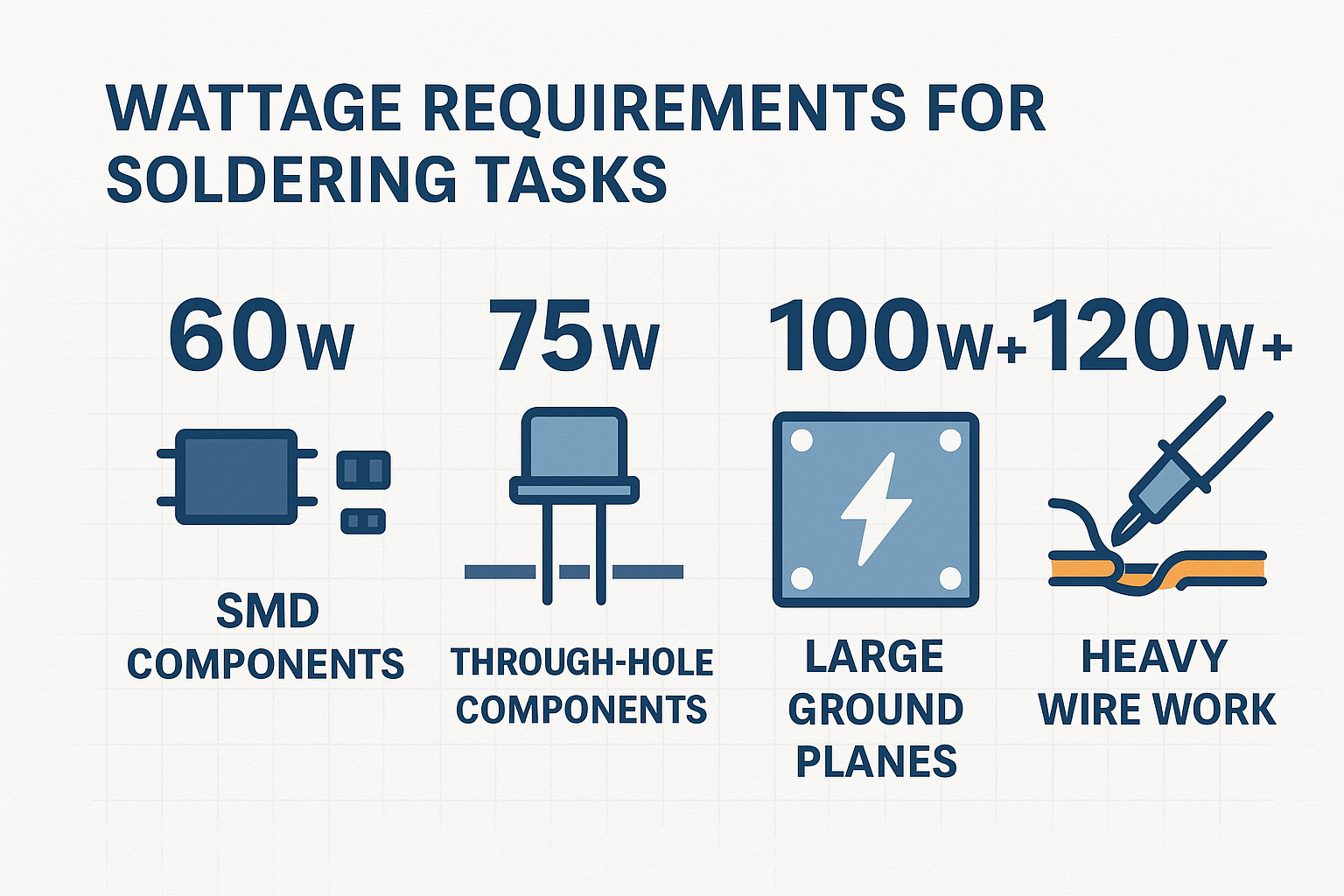
For the majority of electronics work, a well-designed 60-80 watt station provides all the thermal capacity you’ll ever need. Here’s what falls comfortably within this range:
Perfect Applications for Moderate Wattage
SMD Components (0402 to QFP packages)
- Requires precise, controlled heat
- Excess wattage can damage sensitive components
- Focus on tip geometry over raw power
Standard Through-Hole Work
- Resistors, capacitors, and ICs up to 40-pin packages
- Most hobbyist and prototype work
- Educational and learning applications
Wire Splicing and Connector Work
- Up to 16 AWG wire
- Standard automotive connectors
- Electronics repair work
“I’ve completed thousands of repairs with my 65-watt station. The key isn’t more power – it’s understanding thermal dynamics and choosing the right approach for each joint.” – Senior Electronics Technician
Optimizing Your Current Station
Before considering an upgrade, maximize your existing station’s potential:
Tip Selection Strategy
The right tip compatibility can transform your station’s effectiveness. A chisel tip transfers heat more efficiently than a conical tip for most applications.
Temperature Management
Understanding lead-free vs leaded temperature requirements helps you work more efficiently within your wattage limits.
When You Actually Need More Power
Higher wattage becomes essential when dealing with significant thermal mass or heat sinking situations. Here’s when you should seriously consider upgrading:
High-Demand Applications
Large Ground Planes
- Multi-layer PCBs with extensive copper pours
- RF and power electronics
- Industrial control boards
Heavy Gauge Wire Work
- 12 AWG and thicker conductors
- Power supply modifications
- Automotive wiring harnesses
Production Environments
- Continuous operation requirements
- Time-sensitive assembly work
- Multiple operators sharing equipment
Thermal Challenges That Demand Power
| Application | Recommended Wattage | Why Higher Power Helps |
|————-|——————-|———————-|
| 4-layer PCB with ground plane | 80-120W | Overcomes heat sinking |
| 10 AWG wire splicing | 100-150W | Heats large conductor mass |
| Lead-free production work | 80-120W | Higher melting temperatures |
| Continuous 8-hour shifts | 100W+ | Maintains performance |
The Hidden Factors That Matter More
Thermal Recovery Speed
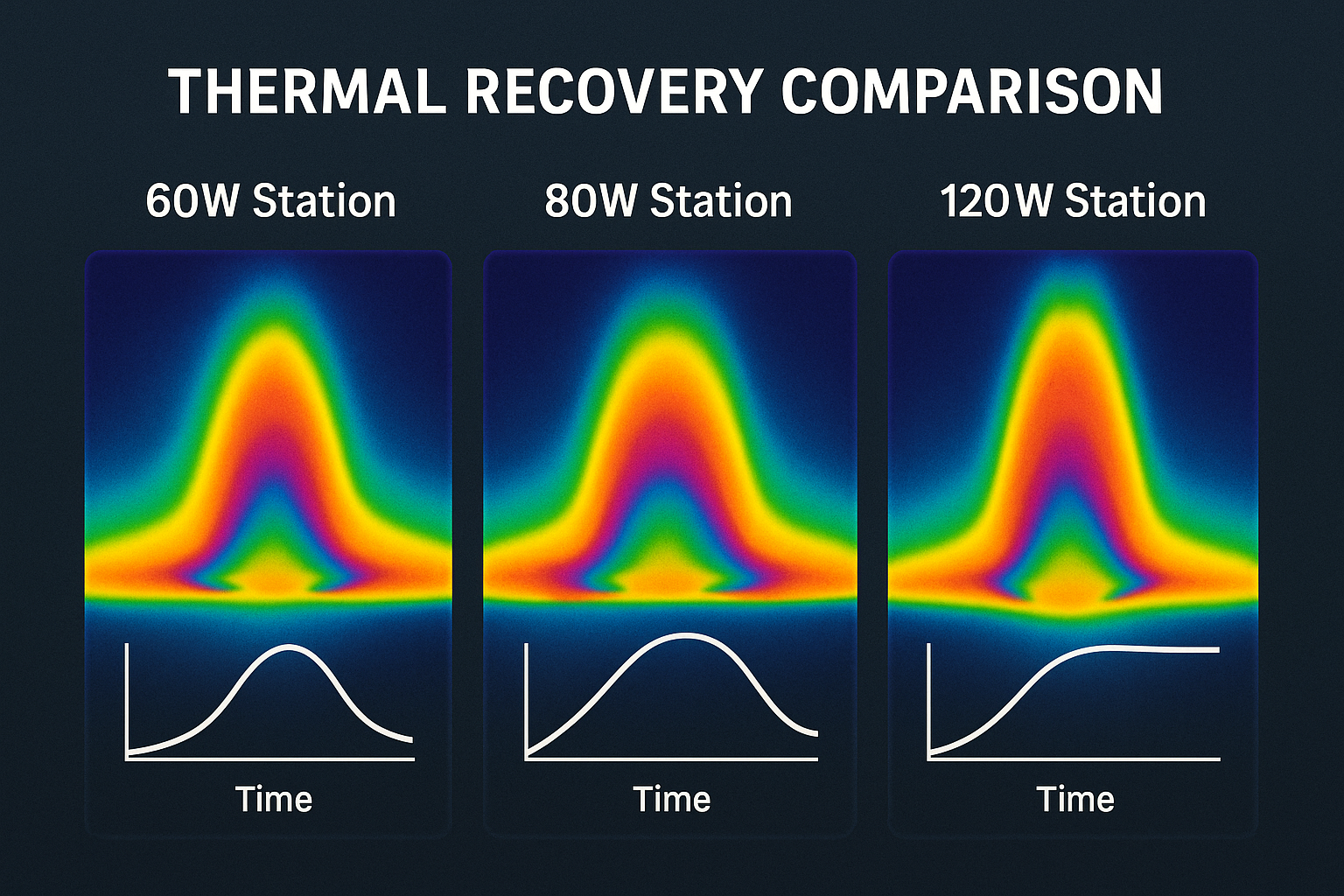
What it means: How quickly your station returns to set temperature after making a joint.
A quality 75-watt station with excellent thermal recovery often outperforms a cheap 120-watt station with poor control circuitry. This is where understanding different personas and workflows becomes crucial.
Tip Thermal Mass
Larger tips store more heat energy, effectively multiplying your station’s thermal capacity. A 60-watt station with a large chisel tip can handle jobs that would challenge a 100-watt station with a tiny conical tip.
Station Design Philosophy
Modern stations focus on efficiency over raw power. Features like:
- Auto-sleep and energy management
- Precise temperature sensing
- ESD protection
These matter more than wattage for most users.
Real-World Wattage Scenarios
Scenario 1: The Hobbyist’s Dilemma
Situation: Weekend projects, Arduino boards, occasional repairs
Recommendation: 60-75 watts is perfect
Why: Provides excellent control without overkill, cost-effective, handles 95% of hobbyist needs
Scenario 2: The Professional Repair Tech
Situation: Daily repairs, various PCB types, time pressure
Recommendation: 80-100 watts for versatility
Why: Handles unexpected thermal challenges, maintains productivity across diverse work
Scenario 3: The Production Engineer
Situation: Continuous operation, large assemblies, multiple operators
Recommendation: 100-150 watts minimum
Why: Ensures consistent performance under demanding conditions
Ergonomics vs. Power Trade-offs
Higher wattage stations often mean larger, heavier handpieces. Consider the ergonomic implications for extended use:
Comfort Factors:
- Handpiece weight and balance
- Cable flexibility
- Heat dissipation from the handle
- Grip comfort during long sessions
Sometimes a moderate-wattage station with superior ergonomics delivers better results than a powerful but uncomfortable alternative.
Making the Right Choice for Your Needs
Assessment Questions
Before upgrading, honestly evaluate:
- What’s the largest thermal mass I regularly work with?
- Do I experience temperature drops during normal work?
- Am I limited by heat-up time or thermal recovery?
- Would better tips or technique solve my current challenges?
The Sweet Spot for Most Users
For 90% of electronics work, a 75-80 watt station with quality temperature control represents the optimal balance of:
- Sufficient thermal capacity
- Precise control
- Cost effectiveness
- Versatility across applications
Cost-Benefit Analysis
When NOT to Upgrade
- Your current station handles your typical work well
- Temperature stability meets your needs
- You’re not experiencing productivity limitations
- Budget constraints make upgrading impractical
When Upgrading Makes Sense
- Consistent thermal challenges with current work
- Expanding into more demanding applications
- Professional requirements demand better performance
- Current station lacks modern safety features
Ready to optimize your soldering setup? Shop XYTRONIC soldering stations to find the perfect balance of power, precision, and value for your specific needs.
Advanced Considerations
Heat Delivery Efficiency
Modern stations achieve remarkable heat delivery efficiency through:
Smart Heating Elements
- Ceramic heaters for rapid response
- Integrated temperature sensors
- Optimized thermal coupling
Advanced Control Algorithms
- Predictive temperature control
- Load-sensing adjustments
- Thermal overshoot prevention
Future-Proofing Your Investment
Consider your evolving needs:
- Skill development – Will you tackle more challenging projects?
- Technology trends – Are components getting larger or smaller in your field?
- Workflow changes – Will production demands increase?
Safety and Wattage Considerations
Higher wattage doesn’t just mean more capability – it also means greater responsibility. Understanding proper safety protocols becomes even more critical with powerful stations.
Safety Scaling Factors:
- Tip temperatures reach dangerous levels faster
- Thermal mass increases burn risk
- ESD considerations may change
- Workspace ventilation becomes more important
Conclusion
The question isn’t whether you need more wattage – it’s whether you need better thermal management for your specific applications. For most electronics engineers and hobbyists, a well-designed 60-80 watt station with quality temperature control, proper tip selection, and good technique will handle virtually any task you encounter.
Your next steps:
- Evaluate your current thermal challenges honestly
- Optimize your existing setup with better tips and technique
- Consider upgrading only if you face consistent thermal limitations
- Focus on station quality over raw wattage numbers
Remember: the best soldering station is the one that reliably delivers the thermal performance you need, when you need it, without compromise. Sometimes that’s 60 watts, sometimes it’s 150 watts – but it’s always about matching the tool to the task.
For more insights on optimizing your soldering workflow, explore our comprehensive soldering station blog for expert tips and detailed guides.